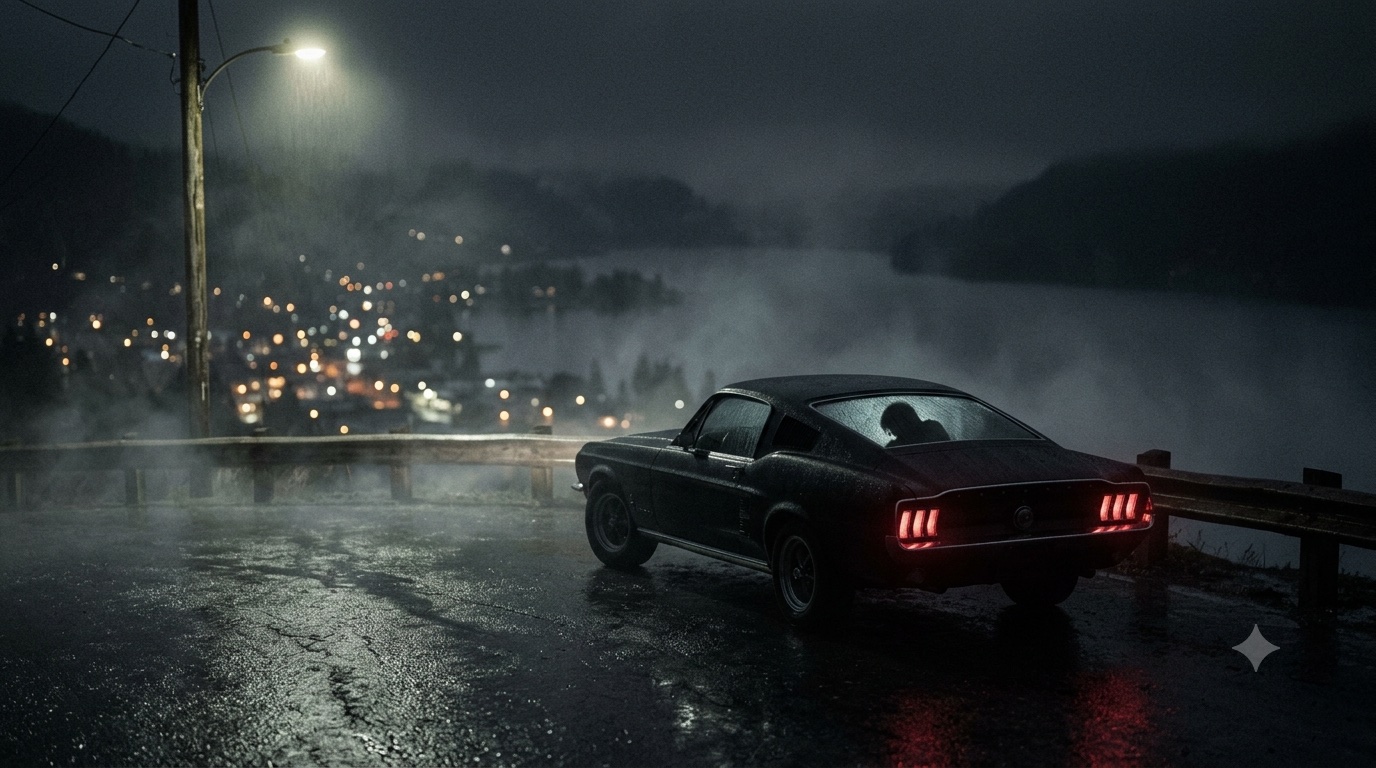
The Car Was Sealed. The Bullet Didn't Care.
A locked-room murder on four wheels. Every clue you need is in this story.

The overlook above the lake is where people go when they want the town beneath them and nobody beside them.
Frans Vos went there almost every evening that summer. Same routine. He would park facing the water, light a cigarette, and let the radio play until the light was gone.
On Thursday morning, a jogger found him still parked there.
The engine was off. The radio was still murmuring. And Vos was in the driver’s seat with a single gunshot wound, hours old.
The first officers on the scene walked around the car twice before anyone said out loud what they were all thinking.
Every window was closed. Fully closed, and intact. Not a crack, not a chip. The windshield was whole. The doors were shut. The forensics team went over every centimeter of the body panels and found the paint unbroken. There was no bullet hole anywhere in the glass or the metal. They even checked the floor pan and the roof lining above his head. Nothing.
A man shot dead inside a car the bullet could not have entered.
By noon, the theories were getting desperate. Maybe he was shot somewhere else and placed in the car. But the blood said no. He had been sitting exactly there when it happened, hands low, relaxed. Maybe the killer sat inside with him and closed the door on the way out. But the shot had come from above, angled down through his shoulder. Nobody fires down like that from a passenger seat. The angle belonged to someone standing. Standing right next to a man who never even raised his hands.
That was the other thing. Vos never saw it coming. Or he saw it coming and didn’t care. No struggle. No panic. As if the last thing that happened to him was a conversation.
The younger detective, Rens, stayed with the car while the others went to pull Vos’s phone records. She kept a list of details that were too small for the morning briefing:
A moth on the dashboard, dead, wings folded. Fresh mosquito bites on Vos’s left forearm, a dozen of them, from that night. And a thin line of cigarette ash on the outside of the driver’s door, just below the window. His brand. His cigarette, resting where his hand must have been.
She stood there for a long time, looking at a sealed car that insects had somehow visited, that ash had somehow crossed, that a bullet had somehow entered from above.
Then she walked around it once more, slowly, and stopped. She looked at the car, really looked at it, and radioed the others to come back.
“Stop asking how the bullet got in,” she said. “Ask what this car looked like at sunset.”
How did the killer shoot him?
The car was a convertible.
When Vos was shot, there was no roof above him at all. It was a warm summer night at his favorite spot above the lake. He was sitting under the open sky. The killer simply walked up to the driver's side and fired down at him. No glass in the way. No metal. Nothing to leave a hole in.
Then the killer reached past the body, pressed one button, and held it. The roof unfolded and locked itself shut over the dead man. A sealed car, built around the body after the shot.
Every strange detail fits. The downward angle of the shot: a killer standing over a seated man in an open car. The moth on the dashboard and the fresh mosquito bites: the night air had been inside the car with him. The ash on the outside of his door: he had been resting his cigarette hand on top of it, in the open air.
Rens had walked around the car and understood that the question was wrong. Nobody shot through a sealed car. The car was only sealed afterward, because the roof of a convertible does not leave a mark when it closes.
Reactions 0
Loading…